Matata Mapon, the new Prime Minister is known as a good technocrat. His major accomplishment as Finance Minister was the debt alleviation package. In July 2010, just days after the 50 year independence celebrations, DRC reached the Completion Point under the HIPC initiative. This meant that $12.3 billion of Congo’s $13.1 billion debt stock was forgiven. Matata was previously a respected manager of the World Bank’s Bureau Central de Coordination (BCECO).
A lesser-known fact about Matata is his academic work. In 1999 he co-signed a really excellent book with François Kabuya Kalala: l’Espace Monétaire Kasaïen: Crise de légitimité et de souveraineté monétaire en période d’hyperinflation au Congo (1993-1997), published by CEDAF/Africa Museum/L'Harmattan. Jean-Claude Masangu Muongo, who was already Governor of the Central Bank, signed the forward.
The book analyzes how the two Kasai provinces refused to use new Zaire notes for over five years, while continuing to use demonetarized notes. The bills were very badly worn and had no legal basis but people believed in them. The creation of this unusual monetary space enabled the Kasais to avoid some of the serious macroeconomic problems that crippled other parts of the country. The book was well-received by Congo economy experts.
For a look at this other dimension of Matata-the-academic, see l’Espace Monétaire Kasaïen.

Monday, 23 April 2012

Sunday, 15 April 2012
Chebeya Film Banned in Congo

Thierry Michel’s tragicomic film about the political assassination of human rights activist Floribert Chebeya has been banned in Congo.
After seeing the film, I was amazed that Michel had even been allowed to document the masquerade trail of Chebeya’s murderers.
But after its release in Europe and the US where it won numerous prizes such as the Grand Award at the International Human Rights Film Festival in Paris, Luzolo Bambi (Minister of Justice and Human Rights) formally requested the Congolese National Censorship Commission to ban the film’s distribution and showing. Why? Because certain sequences are allegedly disrespectful to President Kabila.
The trial’s outcome was disappointing. Lower-ranking henchmen were found guilty but the boss and probable godfather of the murder, John Numbi, was not put on trial. General Police Inspector Numbi was Kabila’s security boss from 2007 until his suspension in June 2010 following the international outcry caused by the murder. This native of North Katanga was not sacked but suspended and replaced by the Tutsi general Charles Bisengimana.
Very close to the president, Numbi was the architect of some special operations such as the joint Rwanda-Congo military operation in North Kivu and the bloody repression of the Bundu dia Kongo political religious movement in Bas-Congo. Numbi is too close to the president and knows too much to be put on trail.
The ban is an embarrassment for some European sponsors from France and Belgium that planned on showing the film in their cultural centers in Congo. It even puts into question holding the IOF Francophonie international jamboree in Kinshasa in October this year.
It would be shameful for the IOF to hold such an important summit in Congo until progress in the democratic process has been made.
The assassination of Floribert Chebeya - and Fidele Bazana who is commonly described as his driver but who in fact was a respected colleague of the Voix des Sans Voix leader is a hideous blemish on Joseph Kabila’s record.
It does however prove that some people in Congolese civil society refuse to be intimidated and dare to speak out. Chebeya’s fight, thanks in part to Thierry Michel’s documentary, lives on.
The US National Endowment for Democracy honored Floribert Chebeya posthumously with its Democracy Service Medal. Past awardees include Lech Walesa, Vaclav Havel and the Dalai Lama.
Wednesday, 11 April 2012
Priorities of Congolese Citizens
'Reach Out to Us: Findings from Focus Groups with Young Men and Women in the DRC' is a timely and informative report produced by the National Democratic Institute for International Affairs.
Based on a focus group methodology, the report found that Congolese are primarily concerned about their economic subsistence. They want jobs and security; they are extremely unhappy with the current state of their country and they hold the government responsible for not addressing the country’s woes. People dream of a country where their basic needs are taken care of and where they can live in peace.
The report's findings are hardly surprising. The approach (twelve discussions in six provinces) may even be perceived as naïve, superficial or unrepresentative. Nonetheless, its message and approach are important.
Congo Masquerade repeatedly made the point that reform and development strategies in DRC fail because they are designed and implemented by experts who are disconnected from local reality and ordinary peoples’ perceptions of what needs to be done. Primary beneficiaries – the people- are insufficiently informed, consulted and engaged. State-building strategies are imposed upon them - they are not embedded in their expectations or needs.
By giving voice to the people, this report sends a clear message to Congolese authorities and international partners who now have meaningful political information from the streets and villages of Congo of how people see their future.
Based on a focus group methodology, the report found that Congolese are primarily concerned about their economic subsistence. They want jobs and security; they are extremely unhappy with the current state of their country and they hold the government responsible for not addressing the country’s woes. People dream of a country where their basic needs are taken care of and where they can live in peace.
The report's findings are hardly surprising. The approach (twelve discussions in six provinces) may even be perceived as naïve, superficial or unrepresentative. Nonetheless, its message and approach are important.
Congo Masquerade repeatedly made the point that reform and development strategies in DRC fail because they are designed and implemented by experts who are disconnected from local reality and ordinary peoples’ perceptions of what needs to be done. Primary beneficiaries – the people- are insufficiently informed, consulted and engaged. State-building strategies are imposed upon them - they are not embedded in their expectations or needs.
By giving voice to the people, this report sends a clear message to Congolese authorities and international partners who now have meaningful political information from the streets and villages of Congo of how people see their future.
Thursday, 5 April 2012
Political Maturity in Congo
The obvious news coming out of Congo
Examples of political maturity on the part of ordinary Congolese seem to me, however, to be under-reported. I spent a good part of March in Congo Kinshasa
Informants bitterly reported that authorities (particularly those at the CENI ) proved to be brilliant in their ability to cheat and manipulate the electoral process. But there was also a clear sense of awareness, maturity, patience and good judgement on the part of ordinary people. They claim to be info rmed of what is going on on the political landscape. They are committed to keeping Kabila under scrutiny saying ‘ce Monsieur doit être plus prudent’ and ‘la pression peut affaiblir’.
Despite the huge potential for post-electoral violence, people did not express strongly felt political frustration through violent means. There were incidents but these were relatively limited. Most of the violence that did take place was carried out by the police and military – not by the people.
The discourse of violence also mutated. Heeding the lessons of the Arab Spring, Kinois claim their cell phones (tshombo) are their weapons and text messages bullets. This was a concern to the government which shut down SMS transmission from 3-28 December.
Another example of maturity is voting patterns. Of course we don’t really know who won the presidential vote but the legislative results are truly remarkable. The vast majority of MPs who sat in the previous legislature were not re-elected. They were sanctioned for not delivering on their 2006 promises. They voted themselves $6,000 per month salaries and perks while neglecting social priorities.
People also said that the free tee shirts and tins of sardines that were distributed on the campaign trail were not going to influence their vote as in the past.
Important political figures – even some Ministers (José Endundo - Environment, Alexis Tambwe Mwamba – Foreign Affairs, Martin Kabwelulu - Mining, Raymond Tshibanda - International Cooperation…) were not re-elected. This proves that a well financed campaign is not enough to maintain the trust of a frustrated constituency.
Important political figures – even some Ministers (José Endundo - Environment, Alexis Tambwe Mwamba – Foreign Affairs, Martin Kabwelulu - Mining, Raymond Tshibanda - International Cooperation…) were not re-elected. This proves that a well financed campaign is not enough to maintain the trust of a frustrated constituency.
Alphonse Awenza Makiaba, a man with no political experience who feeds his family by transporting bags of rice and manioc on his bicycle, was elected to represent the city of Kisangani at the national level! This candidat des pauvres generated massive popular support precisely because voters could empathize with him.
While ethnicity structures Congolese society, last year’s voting was not always tribal. The election of Désiré Khonde Vila-ki-Kanda is a case in point. Originally from Bas-Congo where he ran and lost in 2006, he now won a seat in the North Kivu city of Goma
Dictatorship, war and social stagnation have taught Congolese to be patient. And patience is another sign of political maturity. While some people say that the election fiasco has discouraged them in participating in the voting exercise, others are already gearing up for the next round in 2016.
Friday, 23 March 2012
L'économie politique post-conflit de la RDC
La Section de l’Histoire du Temps Présent du Musée royale de l’Afrique centrale publie la collection Cahiers africains depuis 1993. Spécialisés en matière d’analyse politique, sociale et économique de la RDC, les manuscrits passent par un processus de peer review avant publication.
Nous avons reçu un manuscrit en français sur l’économie politique de la RDC depuis la transition post conflit et cherchons dès lors deux experts pour le peer review. Si ce travail vous intéresse, merci de me contacter : theodore.trefon@africamuseum.be.
Ce travail est non rétribué mais donne droit au choix d’un ouvrage de la collection.
Le volume (de 250 pages) est constitué des chapitres suivants :
1. L’analyse socio-économique de la guerre : Essai de modélisation théorique et évidences empiriques.
2. Transition démocratique et croissance économique.
3. La réhabilitation du système financier en période post-conflit.
4. Les stratégies gouvernementales de sortie de crise : Le programme des 5 Chantiers de la République et la coopération entre le FMI et la RDC.
5. La promotion de l’entrepreneuriat en période post-conflit.
6. Les défis de l’environnement international.
7. Reforme financière et croissance économique : Les dilemmes de la mise en œuvre du DSCRP en RDC.
8. Décentralisation et reforme de la fiscalité en RDC.
9. La dynamique des réseaux d’assurance mutuelle et informelle constitue-t-elle un filet de sécurité en période de conflit ou de post-conflit ?
Nous avons reçu un manuscrit en français sur l’économie politique de la RDC depuis la transition post conflit et cherchons dès lors deux experts pour le peer review. Si ce travail vous intéresse, merci de me contacter : theodore.trefon@africamuseum.be.
Ce travail est non rétribué mais donne droit au choix d’un ouvrage de la collection.
Le volume (de 250 pages) est constitué des chapitres suivants :
1. L’analyse socio-économique de la guerre : Essai de modélisation théorique et évidences empiriques.
2. Transition démocratique et croissance économique.
3. La réhabilitation du système financier en période post-conflit.
4. Les stratégies gouvernementales de sortie de crise : Le programme des 5 Chantiers de la République et la coopération entre le FMI et la RDC.
5. La promotion de l’entrepreneuriat en période post-conflit.
6. Les défis de l’environnement international.
7. Reforme financière et croissance économique : Les dilemmes de la mise en œuvre du DSCRP en RDC.
8. Décentralisation et reforme de la fiscalité en RDC.
9. La dynamique des réseaux d’assurance mutuelle et informelle constitue-t-elle un filet de sécurité en période de conflit ou de post-conflit ?
Sunday, 11 March 2012
Cinq chantiers rebaptized révolution et modernisation in Congo
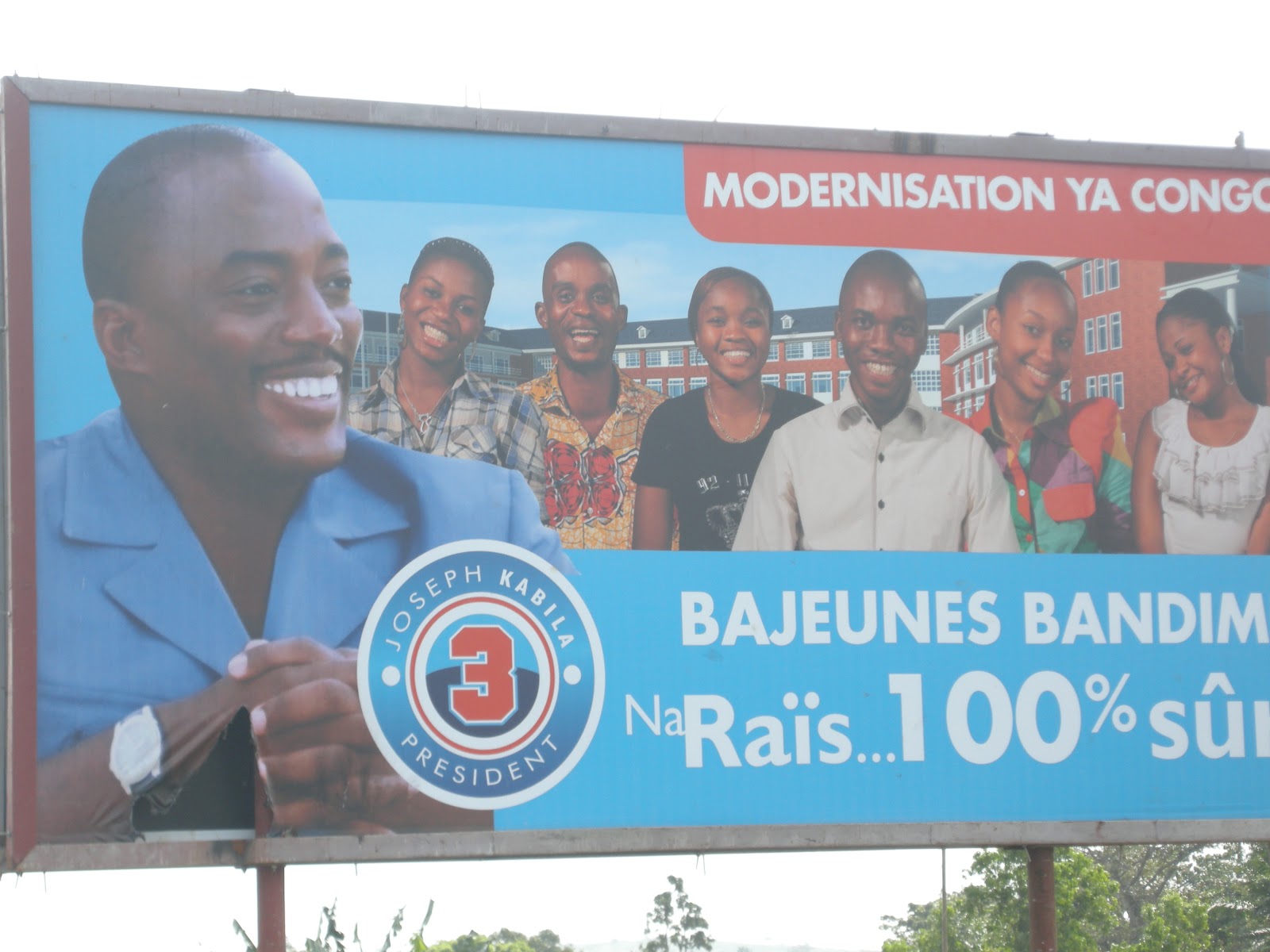
The development programme launched in 2008 was a flop. Just like Kabila’s strategy to call 2010 l’année sociale, it was poor political strategy to campaign on. By the time the campaign officially opened, even the government had to admit that everyone recognised cinq chantiers as empty propaganda.
One of his worst scores was paradoxically precisely where some road improvements were made: the nation’s capital where Kabila has become persona non grata. Some central areas of Kinshasa (mainly the boulevards 30 Juin, Triomphal and Lumumba) benefited from road and infrastructure improvements carried out by the Chinese but the programme has not extended into the provinces. The other priorities, health and education, water and electricity, housing and employment did not produce any results.
Presidential candidate Nzanga Mobutu who was Minister of Agriculture under Kabila declared on Radio France International that there was never any discussion of cinq chantiers during cabinet meetings, adding that the programme was thought up by the Kabila parallel government.
A well-known opposition singer Bill Clinton (not to be confused with the former US president) produced a video clip showing an exasperated father taking his son by the hand to the renovated Boulevard de 30 Juin, telling him, if you are hungry, eat that! The message is that some prestige road work does not help the Kinshasa poor and hungry.
Hatuone kitu is Swahili for ‘we don’t see anything’. It is also the title of a song sung during the electoral campaign in Bukavu referring to the fact that there were no cinq chantiers projects in the Kivus.
Kinois cleverly transformed the name on a State-controlled television programme Cinq chantiers en marche (moving ahead) into cinq chantiers en marche arrière (going in reverse). Further mocking the slogan, they also say that personal struggle for life is their sixième chantier.
A mid-ranking civil servant working in the Ministry of Higher Education told me that until a few months ago, if he ever omitted mentioning cinq chantiers in any kind of project, his boss would say to him: ‘Do you want me to have problems with the Minister?’ Today, if he inadvertently does mention cinq chantiers, he is asked exactly the same question.
Sunday, 19 February 2012
Soldiers mutiny in Ituri

Radio Okapi and other media have reported a mutiny of two battalions – approximately 2,000 soldiers in Marabo (40 kilometers from Bunia ) in the north east Ituri territory. The mutiny is yet another blow to the Kabila’s fragile authority.
Salary problems started the movement. Last year a census was taken to establish the number of men in uniform compared to the ghost soldiers whose salaries were used to reinforce their pay. Once the ghost soldiers were removed from the payroll, real soldiers saw a cut in their pay.
A letter was sent to President Kabila complaining of the inhuman conditions soldiers are forced to brook and SMS messages were sent to the heads of the regional military authorities to reiterate their dissatisfaction. Their complaints read more like an NGO diatribe than a military declaration.
Major Faustin Balizana, adjunct commander of the 42nd battalion and spokesman for the rebellious troops, said soldiers continue to be poorly paid and are taken advantage of from the military upper echelons. He made explicit reference to the existence of mafia-style networks of corruption and theft of money that should go to foot soldiers.
Prior to the mutiny, approximately 30 well-armed soldiers deserted. Some headed back to their base but others are still on the loose in the vicinity of the Lubero forest.
200,000 national army troops and the majority of MONUSCO blue helmets are deployed in the east. They have not succeeded in bringing local militias, FDLR, FNL and the Lords Resistance Army under control. The political economy of plunder and blood minerals earnings are strong incentives to continue sabotaging the security landscape.
Subscribe to:
Posts (Atom)