It won’t be a surprise to anyone if the presidential elections slated to take place the end of this year don’t take place. Not a surprise but certainly a disappointment; especially to opposition politicians, ordinary Congolese and some Western partners who have stuck their necks out voicing the importance of rule of law and democratic process.
President Joseph Kabila doesn’t care what the Constitution says about two mandates and will cling to power as long as he can. Some analysts consider he will more likely be assassinated than walk away from power voluntarily. Why? Because he controls access to substantial natural resources; so the incentive to remain at the top of the pyramid is strong.
Legal instruments relating to the mining and oil sectors (designed with international advisory – mainly World Bank) put him at the top of the decision-making process. His signature is needed in the awarding of exploitation concessions in these sectors.
Oil is the country’s third most important export earner (after copper and cobalt). Global Witness has reported frightening stories involving Kabila, Dan Gertler and the Congolese oil business.
Mineral exports may have slumped in the past year, negatively impacting export earnings. But Congo’s resource base is resilient and will bounce back. One indicator is China’s increasing control of cobalt supply chains and investments in DRC. About half of the world’s cobalt comes from Katanga and demand is going to increase as automotive manufacturers from Teslar to General Motors increase production of electric batteries. Cobalt is necessary to build them.
Some natural resource sectors are more sensitive to the political context than others. Last month the World Bank suspended financing to an Inga 3 technical assistance project. The underdevelopment of energy capacity is a major driver of deforestation.
The Belgian Federal Parliament, also last month, adopted a resolution to freeze direct aid to Kinshasa if elections aren’t held. Belgian projects in the agriculture, conservation and infrastructure sectors would consequently be put on hold.
US Senators Richard Durbin, Edward Markey and Christopher Murphy introduced a Senate resolution calling on Kabila's government to fulfil its constitutional mandate for a democratic transition while calling for targeted sanctions such as visa bans and asset freezes.
Opposition candidates/Kabila rivals like Etienne Tshisekedi and Moise Katumbi are preoccupied with getting into the Presidential palace but have been relatively silent about their macro-economic and social programs.
They should be called upon to outline their strategies for regaining sovereignty over the Congo’s natural resource base.

Showing posts with label Joseph Kabila. Show all posts
Showing posts with label Joseph Kabila. Show all posts
Friday, 5 August 2016

Thursday, 5 February 2015
Demonstrations against Kabila
Here is a link to an interview with me conducted by Francois Misser and posted on Dominic Johnson's blog. A shorter version appeared in the German newspaper TAZ.
The message in a nutshell is this: Joseph Kabila is not about to walk away from power in 2016. The parliamentary compromise is no more than a tactical withdrawal.
http://blogs.taz.de/kongo-echo/2015/02/03/theodore-trefon-on-the-telema-protests/
The message in a nutshell is this: Joseph Kabila is not about to walk away from power in 2016. The parliamentary compromise is no more than a tactical withdrawal.
http://blogs.taz.de/kongo-echo/2015/02/03/theodore-trefon-on-the-telema-protests/
Saturday, 16 June 2012
Disappointing European Parliament Resolution

The European
Parliament published a resolution on
the follow-up of the elections in the Democratic Republic of Congo on 14 June.
It is a disappointing benediction of Kabila’s struggle to hold on to
power. Kabila is gradually securing an important diplomatic objective as time
goes by: European recognition as Congo ’s de facto leader.
The question of electoral legitimacy is fading out of the diplomatic debate.
European MPs lack either
the political will or the understanding of the Congolese political landscape to
issue a more meaningful declaration. The only relatively harsh statement in the
resolution is that results of the November 28th elections remain ‘questionable’
due to ‘the lack of proper monitoring of these key electoral processes’.
Given the honest and
critical report of the EU monitoring team led by Maria Nedelcheva, we could
have expected European MPs to take a firmer stance.
Their resolution can be interpreted as wishful thinking for improved
governance, utopian sentiments about Kabila’s good intentions, or worse –
outrageous cynicism (we don’t really approve of Kabila but given his
vulnerability we can deal with him and can carry on with business-as-usual).
Does anyone really care about the Congolese? Apparently European Members
of Parliament do not.
Sunday, 10 June 2012
Matata, M23, Bosco Ntaganda: ‘Whiz kid’ in trouble
Despite a good dose of indulgence and wishful thinking, the news coming out of eastern Congo proves that Augustin Matata Mponyo’s government of ‘whiz kids’ (les surdoués) is in deep trouble.
The Matata government is unable to control the mutinies of FARDC troops loyal to CNDP’s Bosco Ntaganda in the Kivus and the commercial and military operations of the Rwandan-infiltrated M23 rebel group.
Matata lost credibility when a two-day transport strike brought Kinshasa to a standstill last month.
The World Bank suspended budgetary support in response to the poor management of the post-election crisis.
The UK government at the end of 2011 announced it would double its aid to Congo in 2012 but in March backtracked on that plan.
In the wake of botched elections in which no one really knows who won, Kabila needed to send some kind of positive message to international donors. So he appointed one of Congo’s better respected technocrats as Prime Minister. Matata Mponyo had previously earned credibility by his negotiations the World Bank and IMF officials while Finance Minister.
In July 2010, DRC reached the Completion Point under the HIPC initiative. This means that $12.3 billion of Congo’s $13.1 billion debt stock was forgiven. Strict criteria were required, including publishing information on partnerships with mining companies, improving the foreign investment environment, improving fiscal transparency and approving a law governing procurement practices. Implementing the Strategic Plan for Growth and Poverty Alleviation (DSCRP) that emphasized pro-poor spending was also a condition.
Granting Congo Completion Point status was based much more on political considerations than macroeconomic results. There was political motivation to stabilize Kabila in view of the then upcoming 2011 presidential elections. Matata, who is often described as ‘a brilliant technocrat’, provided Kabila with loyal service in these negotiations.
Matata survived with minor injuries the plane crash in which Augustin Katumba Mwanke died in February. Matata’s aura and the symbolism of walking out of a plane crash that killed someone more powerful than himself is not insignificant in Congolese culture.
But the image of being Congo’s top finance technocrat and a survivor has not really helped Matata manage the security challenges in the east.
Hailing from Maniema, which is neither a political nor economic high stake province, is emerging as a political handicap.
The best financial manager in Congo can’t be expected to master all of the country’s overwhelming challenges to reconstruction. From the security, social and political perspectives the Matata government is under pressure. Time will tell if a hobbled government will be an advantage or a disadvantage to a vulnerable and marginalized president. A weak government could be to Kabila’s advantage.
It’s no longer hakuna matata, but just matata throughout the Congo.
The Matata government is unable to control the mutinies of FARDC troops loyal to CNDP’s Bosco Ntaganda in the Kivus and the commercial and military operations of the Rwandan-infiltrated M23 rebel group.
Matata lost credibility when a two-day transport strike brought Kinshasa to a standstill last month.
The World Bank suspended budgetary support in response to the poor management of the post-election crisis.
The UK government at the end of 2011 announced it would double its aid to Congo in 2012 but in March backtracked on that plan.
In the wake of botched elections in which no one really knows who won, Kabila needed to send some kind of positive message to international donors. So he appointed one of Congo’s better respected technocrats as Prime Minister. Matata Mponyo had previously earned credibility by his negotiations the World Bank and IMF officials while Finance Minister.
In July 2010, DRC reached the Completion Point under the HIPC initiative. This means that $12.3 billion of Congo’s $13.1 billion debt stock was forgiven. Strict criteria were required, including publishing information on partnerships with mining companies, improving the foreign investment environment, improving fiscal transparency and approving a law governing procurement practices. Implementing the Strategic Plan for Growth and Poverty Alleviation (DSCRP) that emphasized pro-poor spending was also a condition.
Granting Congo Completion Point status was based much more on political considerations than macroeconomic results. There was political motivation to stabilize Kabila in view of the then upcoming 2011 presidential elections. Matata, who is often described as ‘a brilliant technocrat’, provided Kabila with loyal service in these negotiations.
Matata survived with minor injuries the plane crash in which Augustin Katumba Mwanke died in February. Matata’s aura and the symbolism of walking out of a plane crash that killed someone more powerful than himself is not insignificant in Congolese culture.
But the image of being Congo’s top finance technocrat and a survivor has not really helped Matata manage the security challenges in the east.
Hailing from Maniema, which is neither a political nor economic high stake province, is emerging as a political handicap.
The best financial manager in Congo can’t be expected to master all of the country’s overwhelming challenges to reconstruction. From the security, social and political perspectives the Matata government is under pressure. Time will tell if a hobbled government will be an advantage or a disadvantage to a vulnerable and marginalized president. A weak government could be to Kabila’s advantage.
It’s no longer hakuna matata, but just matata throughout the Congo.
Sunday, 13 May 2012
Matata's Five-Year Plan
Prime Minister Matata Mapon presented his five-year Programme d’Action du Gouvernement: 2012-2016 to the Congolese National Assembly last week.
Building on President Kabila’s new mantra ‘revolution and modernity’ the programme outlines six ambitious objectives: (i) institutional reform and reinforcing the efficiency of the state, (ii) consolidating macroeconomic stability, accelerating growth and creating jobs, (iii) improving and developing infrastructure, (iv) improving living conditions for the population, (v) stimulating a sense of civism and (vi) improving Congo’s international relations and image.
The programme stipulates – but only in very general terms – how the realization of these objectives is to be financed. Three sources of funding are emphasized: (i) national fiscal revenues, (ii) public-private partnerships and (iii) support from bi- and multinational partners.
The 57-page document provides for very interesting reading. There are examples of critical realism: “L’économie congolaise a enregistré durant la décade 2000-2010 un taux de croissance moyen de 5%. Cette performance ne s’est malheureusement pas traduite par une amélioration correspondante de l’emploi et du bien être de la population” (section 3.1).
Some passages seem more likely to be read in NGO reports or academic papers than in a major official document: “L’amélioration de la gouvernance demeure un défi majeur pour le pays. Faute d’une volonté politique clairement affirmée pour le changement, la révolution mentale que requiert la situation restera un leurre” (section 4).
Last year’s agricultural law stipulates that only Congolese have the right to own land. Foreigners cannot be majority holders. In section 4.2.4 of Matata’s programme a similar constraint is announced. In the aim of promoting the middle class and protecting small shop-owners, “il est prévu de … interdire l’exercise du petit commerce et des petites activités aux étrangers…”.
Other items seem rather far-fetched in a five-year plan: providing villages with more than 500 inhabitants with wells (section 4.4.1.3), building factories to produce pharmaceuticals (section 4.4.1.6) or investing in the production of silica sands for solar panels (section 4.2.2).
The document is admittedly an outline and doesn’t have the ambition of developing in detail its points. Some ideas do nonetheless require clarification. What does this mean? “establish compulsory public service for people over 18” (section 4.5.2) or “humanize living conditions in prisons and make prisoners productive” (section 4.1.5).
Just days after Matata announced this ambitious programme, the President sent it back to the drawing board. Kabila asked the Prime Minister to rethink the ranking of his priorities because his ‘priority of all priorities’ is establishing security in the east.
From a development perspective, the five-year plan makes sense: implementing it however is going to be an uphill battle.
Building on President Kabila’s new mantra ‘revolution and modernity’ the programme outlines six ambitious objectives: (i) institutional reform and reinforcing the efficiency of the state, (ii) consolidating macroeconomic stability, accelerating growth and creating jobs, (iii) improving and developing infrastructure, (iv) improving living conditions for the population, (v) stimulating a sense of civism and (vi) improving Congo’s international relations and image.
The programme stipulates – but only in very general terms – how the realization of these objectives is to be financed. Three sources of funding are emphasized: (i) national fiscal revenues, (ii) public-private partnerships and (iii) support from bi- and multinational partners.
The 57-page document provides for very interesting reading. There are examples of critical realism: “L’économie congolaise a enregistré durant la décade 2000-2010 un taux de croissance moyen de 5%. Cette performance ne s’est malheureusement pas traduite par une amélioration correspondante de l’emploi et du bien être de la population” (section 3.1).
Some passages seem more likely to be read in NGO reports or academic papers than in a major official document: “L’amélioration de la gouvernance demeure un défi majeur pour le pays. Faute d’une volonté politique clairement affirmée pour le changement, la révolution mentale que requiert la situation restera un leurre” (section 4).
Last year’s agricultural law stipulates that only Congolese have the right to own land. Foreigners cannot be majority holders. In section 4.2.4 of Matata’s programme a similar constraint is announced. In the aim of promoting the middle class and protecting small shop-owners, “il est prévu de … interdire l’exercise du petit commerce et des petites activités aux étrangers…”.
Other items seem rather far-fetched in a five-year plan: providing villages with more than 500 inhabitants with wells (section 4.4.1.3), building factories to produce pharmaceuticals (section 4.4.1.6) or investing in the production of silica sands for solar panels (section 4.2.2).
The document is admittedly an outline and doesn’t have the ambition of developing in detail its points. Some ideas do nonetheless require clarification. What does this mean? “establish compulsory public service for people over 18” (section 4.5.2) or “humanize living conditions in prisons and make prisoners productive” (section 4.1.5).
Just days after Matata announced this ambitious programme, the President sent it back to the drawing board. Kabila asked the Prime Minister to rethink the ranking of his priorities because his ‘priority of all priorities’ is establishing security in the east.
From a development perspective, the five-year plan makes sense: implementing it however is going to be an uphill battle.
Sunday, 15 April 2012
Chebeya Film Banned in Congo

Thierry Michel’s tragicomic film about the political assassination of human rights activist Floribert Chebeya has been banned in Congo.
After seeing the film, I was amazed that Michel had even been allowed to document the masquerade trail of Chebeya’s murderers.
But after its release in Europe and the US where it won numerous prizes such as the Grand Award at the International Human Rights Film Festival in Paris, Luzolo Bambi (Minister of Justice and Human Rights) formally requested the Congolese National Censorship Commission to ban the film’s distribution and showing. Why? Because certain sequences are allegedly disrespectful to President Kabila.
The trial’s outcome was disappointing. Lower-ranking henchmen were found guilty but the boss and probable godfather of the murder, John Numbi, was not put on trial. General Police Inspector Numbi was Kabila’s security boss from 2007 until his suspension in June 2010 following the international outcry caused by the murder. This native of North Katanga was not sacked but suspended and replaced by the Tutsi general Charles Bisengimana.
Very close to the president, Numbi was the architect of some special operations such as the joint Rwanda-Congo military operation in North Kivu and the bloody repression of the Bundu dia Kongo political religious movement in Bas-Congo. Numbi is too close to the president and knows too much to be put on trail.
The ban is an embarrassment for some European sponsors from France and Belgium that planned on showing the film in their cultural centers in Congo. It even puts into question holding the IOF Francophonie international jamboree in Kinshasa in October this year.
It would be shameful for the IOF to hold such an important summit in Congo until progress in the democratic process has been made.
The assassination of Floribert Chebeya - and Fidele Bazana who is commonly described as his driver but who in fact was a respected colleague of the Voix des Sans Voix leader is a hideous blemish on Joseph Kabila’s record.
It does however prove that some people in Congolese civil society refuse to be intimidated and dare to speak out. Chebeya’s fight, thanks in part to Thierry Michel’s documentary, lives on.
The US National Endowment for Democracy honored Floribert Chebeya posthumously with its Democracy Service Medal. Past awardees include Lech Walesa, Vaclav Havel and the Dalai Lama.
Sunday, 11 March 2012
Cinq chantiers rebaptized révolution et modernisation in Congo
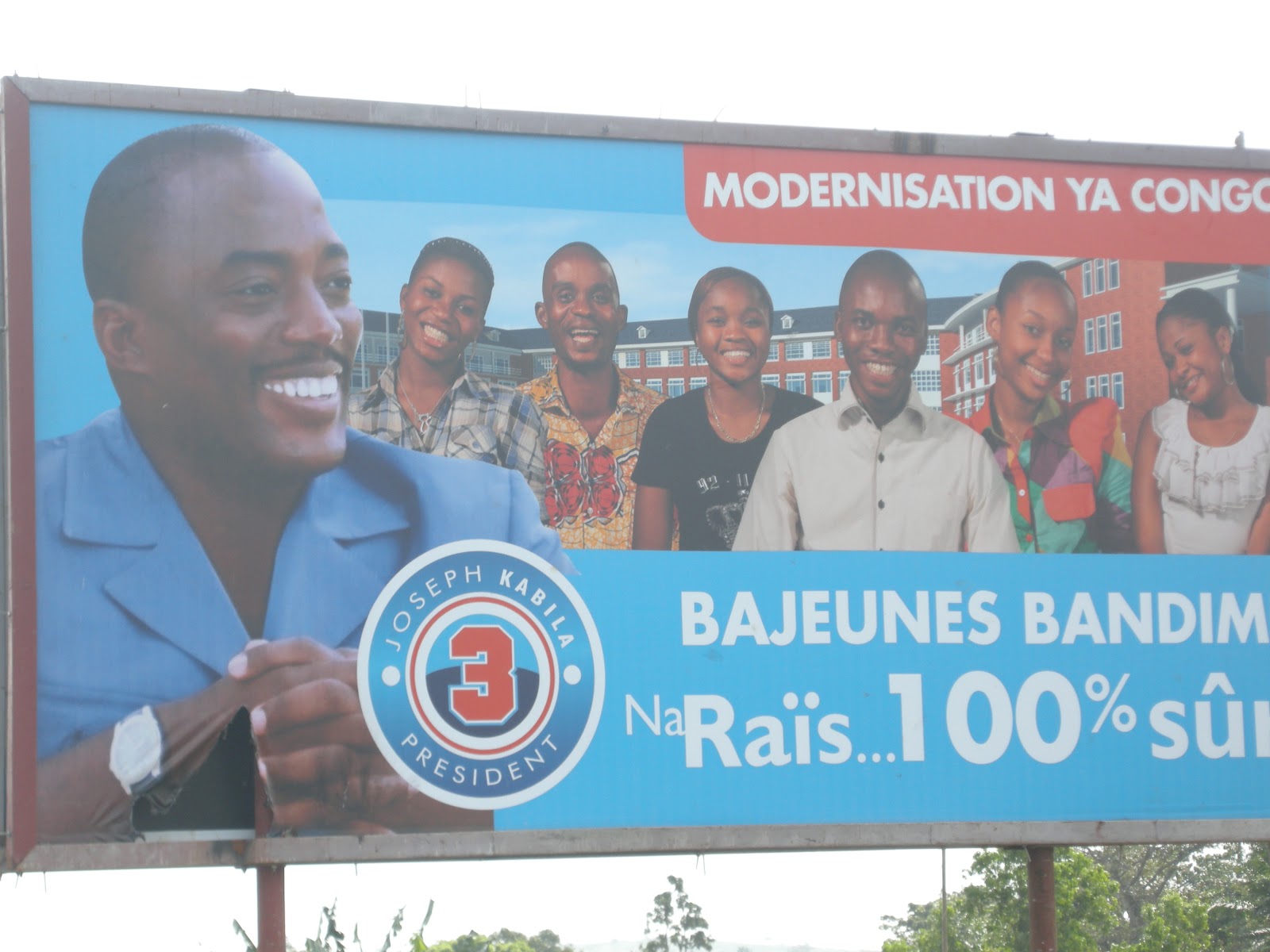
The development programme launched in 2008 was a flop. Just like Kabila’s strategy to call 2010 l’année sociale, it was poor political strategy to campaign on. By the time the campaign officially opened, even the government had to admit that everyone recognised cinq chantiers as empty propaganda.
One of his worst scores was paradoxically precisely where some road improvements were made: the nation’s capital where Kabila has become persona non grata. Some central areas of Kinshasa (mainly the boulevards 30 Juin, Triomphal and Lumumba) benefited from road and infrastructure improvements carried out by the Chinese but the programme has not extended into the provinces. The other priorities, health and education, water and electricity, housing and employment did not produce any results.
Presidential candidate Nzanga Mobutu who was Minister of Agriculture under Kabila declared on Radio France International that there was never any discussion of cinq chantiers during cabinet meetings, adding that the programme was thought up by the Kabila parallel government.
A well-known opposition singer Bill Clinton (not to be confused with the former US president) produced a video clip showing an exasperated father taking his son by the hand to the renovated Boulevard de 30 Juin, telling him, if you are hungry, eat that! The message is that some prestige road work does not help the Kinshasa poor and hungry.
Hatuone kitu is Swahili for ‘we don’t see anything’. It is also the title of a song sung during the electoral campaign in Bukavu referring to the fact that there were no cinq chantiers projects in the Kivus.
Kinois cleverly transformed the name on a State-controlled television programme Cinq chantiers en marche (moving ahead) into cinq chantiers en marche arrière (going in reverse). Further mocking the slogan, they also say that personal struggle for life is their sixième chantier.
A mid-ranking civil servant working in the Ministry of Higher Education told me that until a few months ago, if he ever omitted mentioning cinq chantiers in any kind of project, his boss would say to him: ‘Do you want me to have problems with the Minister?’ Today, if he inadvertently does mention cinq chantiers, he is asked exactly the same question.
Sunday, 12 February 2012
Augustin Katumba Mwanke: profile & analysis

Augustin Katumba Mwanke was Kabila’s éminence grise. His voice in economic matters was taken seriously. Already close to Kabila père, this Katangais (b. Pweto, 1963) was behind the Congo-China deal and was very influential in facilitating relations between the Kinshasa political elite and the mining sector. Although he did hold any official position in the Kabila cabinet, he was former head of the Alliance for the Presidential Majority (AMP).
Kabila already has serious problems managing criticism of the recent elections fiasco. The loss of his main advisor is an additional blow.
This former governor of Katanga (appointed by L.-D.Kabila in April 1998) served on the board of Anvil Mining. He was accused of financial wrongdoing by the UN group of experts investigating the illegal exploitation of Congo natural resources which led to his dismissal from the position of Minister of State Assets (portefeuille de l'Etat).
The profile below is excerpted and adapted from a classified cable by US Ambassador William J. Garvelink.
Known for his business acumen, political discretion and efficiency, Katumba made no secret of his desire to leave the DRC to become ambassador to Israel, Switzerland or South Africa.
Katumba was suspected of having significant health problems. He spent several weeks in South Africa in 2009 for medical treatment. The nature of his health problems is not known but some observers believe he was HIV positive. This theory would seem bolstered by his emaciated physical appearance.
Katumba rarely met with diplomats. He was viewed by many as a kind of shady, even nefarious figure within Kabila’s inner circle. A former financier who lived many years in South Africa before returning to the DRC after Mobutu’s departure, he is believed to have managed much of Kabila’s personal fortune.
He was known to be close to Dan Gertler, a mysterious Israeli trader in precious minerals who, according to some sources, lends Kabila his private jet for trips abroad. Gertler invited Katumba to Israel often. Although Katumba would like to go to South Africa, it seems that Pretoria would not accept him because of suspected illegal banking transactions in the past.
Before the crash, someone made a clairvoyant comment on a Congolese internet forum about Katumba. It seems an appropriate ephitaph: ‘les faucons, ils finirons un jour, croyez-moi’.
Subscribe to:
Posts (Atom)