Showing posts with label motorcycles. Show all posts

Monday, 7 December 2020

Bushmeat: supply and demand in the Kongo Central Province


These traders (it's a man's universe) are organized in a closely knit association

Bushmeat is openly traded along the highway that runs through the Luki Biosphere Reserve in the Kongo Central Province. The most commonly sold species is cane rat but red river hog and antelope are sometimes available. These pictures were taken at a roadside stand on the outskirts of the town of Kinzau-Mvuete 6 December 2020. Traders wave down drivers of SUVs hoping to make a sale.
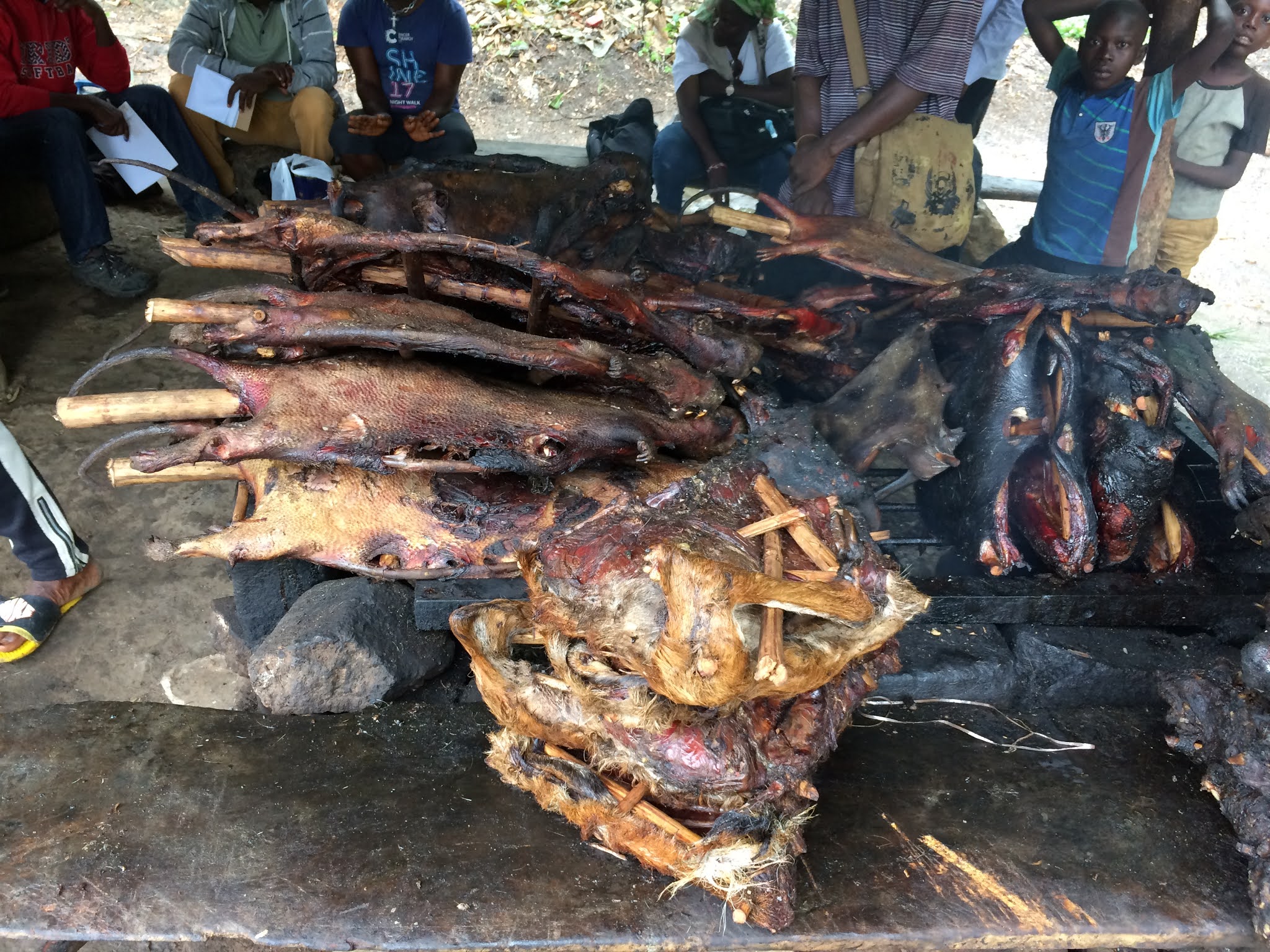
Animals are smoked at the roadside stand

Freshly killed cane rat
Freshly shot cane rat: animals shot are said to taste better than 
animals snared because of fast death/slow death implications.

As wildlife levels diminish in the area, families see their nutrition options change. Children are particularly hard hit because those who consume forest foods have a higher nutrient density than children who do not. An estimated one billion poor people depend on bushmeat for protein, most of the B-vitamin complex and the minerals of iron and zinc. 

Hunters say that the availability of motorcycles is a blessing because they facilitate getting their animals to the traders.
A cane rat this size can sell for five times the price of a kilo of imported chicken thighs.


Smoked cane rat splayed and smoked in a frame of light wood


Partially smoked duiker. 


Farmers hunt cane rats, which in addition to providing cash, eliminates them from their fields. They are pests especially at harvest time as they can ravage entire crops. This is a commonly encountered example of human-animal conflict.

The development of informal commercial networks for urban markets reduces local access to meat because individuals who combine farming and hunting prefer selling wild animals for money instead of putting it into the household pot. They say 'eating bushmeat is like eating money'. A farmer/hunter in the nearby village of Kifudi reported that when he shoots or snares a cane rat, he prefers selling it to buy cheap imported chicken, fish, rice, oil and condiments.

This is a comprehensible paradox because if the family were to eat the cane rat, they wouldn’t have money to buy other foodstuffs. It comes down to selling a relatively small quantity of quality meat to a commercial trader to be able to buy a much larger stock of food that could last longer and feed more family members.

Saturday, 22 February 2014

Motorcycles and agricultural innovation

Mobile phone use took off in Congo in the late 1990s. It transformed society in general while also providing a much needed boost to food production and marketing. It helped communities organize collective transportation which reduced costs and increased security. Farmers became better informed of price fluctuations and market opportunities so were less likely to be taken advantage of by unscrupulous traders and intermediaries. The mobile continues to revolutionize access to banking services such as credit and payments, which still constitute bottlenecks in commodity chains.

The relatively inexpensive motorcycle made in India or China is the social innovation today that is contributing to change in the lives of rural farmers, especially those that live in isolated communities far from feeder roads. Eastern Congolese cities first introduced motorcycles for individual transport and as taxis. Usage has spread rapidly throughout the country. Reluctant at first, Kinshasa’s population has now embraced them for their efficiency in navigating through the capital’s infamous traffic jams. These easily maintained motorcycles are cost efficient and well adapted to the laterite tracks that criss-cross Congo’s rural landscape, even during the rainy season.

As poor road infrastructure is one of the major handicaps for getting crops to market, the motorcycle is a welcome novelty. The heavily laden bicycle is still the more common means of carrying produce, although a slow and exhausting form of labour. It is nonetheless increasingly frequent to see a young man on a motorcycle with a bag of cassava, a plastic jug of palm oil or even a pig or a goat en route to an intermediary drop-off point accessible to pick-up trucks or large lorries. As the purchasing power of the young villager is weak, coming up with the approximately one thousand dollars to buy a 125cc motorcycle is beyond the reach of most. But young men hanker after them, seeing them as the undeniable symbol of modernity, prestige and liberty.

Many of the motorcycles plying Congo’s rural tracks are purchased by traders who advance payment for them in exchange for promises of agricultural goods. Young men consequently enter into a kind of indentured servitude to pay off their debts. Although the motorcycle’s impact is slight in terms of agricultural marketing, it is an emerging positive trend whose ramifications are difficult to predict.While the motorcycle will unlikely contribute significantly to feeding Congo’s towns and cities, it is nevertheless already augmenting rural revenues.