It won’t be a surprise to anyone if the presidential elections slated to take place the end of this year don’t take place. Not a surprise but certainly a disappointment; especially to opposition politicians, ordinary Congolese and some Western partners who have stuck their necks out voicing the importance of rule of law and democratic process.
President Joseph Kabila doesn’t care what the Constitution says about two mandates and will cling to power as long as he can. Some analysts consider he will more likely be assassinated than walk away from power voluntarily. Why? Because he controls access to substantial natural resources; so the incentive to remain at the top of the pyramid is strong.
Legal instruments relating to the mining and oil sectors (designed with international advisory – mainly World Bank) put him at the top of the decision-making process. His signature is needed in the awarding of exploitation concessions in these sectors.
Oil is the country’s third most important export earner (after copper and cobalt). Global Witness has reported frightening stories involving Kabila, Dan Gertler and the Congolese oil business.
Mineral exports may have slumped in the past year, negatively impacting export earnings. But Congo’s resource base is resilient and will bounce back. One indicator is China’s increasing control of cobalt supply chains and investments in DRC. About half of the world’s cobalt comes from Katanga and demand is going to increase as automotive manufacturers from Teslar to General Motors increase production of electric batteries. Cobalt is necessary to build them.
Some natural resource sectors are more sensitive to the political context than others. Last month the World Bank suspended financing to an Inga 3 technical assistance project. The underdevelopment of energy capacity is a major driver of deforestation.
The Belgian Federal Parliament, also last month, adopted a resolution to freeze direct aid to Kinshasa if elections aren’t held. Belgian projects in the agriculture, conservation and infrastructure sectors would consequently be put on hold.
US Senators Richard Durbin, Edward Markey and Christopher Murphy introduced a Senate resolution calling on Kabila's government to fulfil its constitutional mandate for a democratic transition while calling for targeted sanctions such as visa bans and asset freezes.
Opposition candidates/Kabila rivals like Etienne Tshisekedi and Moise Katumbi are preoccupied with getting into the Presidential palace but have been relatively silent about their macro-economic and social programs.
They should be called upon to outline their strategies for regaining sovereignty over the Congo’s natural resource base.

Friday, 5 August 2016

Tuesday, 3 May 2016
Endorsements for Congo's Environmental Paradox
Thank you Ed, Daniel, Crawford, David, Tom and Jeroen.
‘Congo’s Environmental Paradox is a fascinating read, giving a
no-nonsense view of the multitude of problems besetting Congo’s natural
resource sectors, how they affect ordinary people’s daily lives and how
well-meaning donor initiatives are often intrinsically flawed. The book puts today’s
problems into historical perspective and will serve as a reality-check to
politicians and activists.’
Daniel Balint-Kurti, Global Witness
‘An invaluable contribution … the succinct and sparkling summation of
the key elements of the political economy is most useful. The author’s capacity
to convey a rich treasure chest of information and acute analytical skills make
this a landmark work.’
Crawford Young, University of Wisconsin
‘Most studies of natural resources
and development delve into the details sector by sector. Linkages to violence,
politics and state-building are treated separately for different resources.
This eloquent and richly documented book focuses attention on the connections,
and on the global forces adding complexity to these interactions and altering
the political economy of possible change.’
David Booth, Overseas Development
Institute
‘This remarkable, fact-filled study
will undoubtedly rank as required reading for anyone with an interest in the
DRC – whether for specialists or for the general reader. Following his Congo
Masquerade, this should confirm Trefon’s standing as one of the most perceptive
observers and analysts of that central African giant.’
Edouard Bustin, Boston University
‘The first successful attempt to
take stock of emerging trends in Congo’s natural resource sectors.
Well-written, clearly structured and thoroughly documented, Trefon offers fresh
analysis on the gap between resource potential and socio-economic development.’
Jeroen Cuvelier, University of Ghent
‘A remarkable guide to the tangled
relationships between minerals, water and other sectors of the political
economy in the Congo. It goes beyond slogans such as “rich land, poor people”
to explain how the rich get richer while the poor struggle to survive.
Indispensable reading for humanitarians and human rights advocates, both
Congolese and international.’
Tom Turner, author of The Congo
Wars: Conflict, Myth and Reality
Natural Resource Management in the Congo
A preview to the book. Publisher information here: Congo’s Environmental Paradox: Potential and predation in a land of plenty.
Book launch in London at SOAS Monday 9 May 5:15 PM
Book launch in Oxford Tuesday 10 May Nuffield College, Clay Room, 5:00 PM
Book launch in Birmingham Wednesday 11 May 4:00 PM
Book launch in Oxford Tuesday 10 May Nuffield College, Clay Room, 5:00 PM
Book launch in Birmingham Wednesday 11 May 4:00 PM
Congo matters.
It is land of plenty with the natural resources the world needs. No other
country in Africa, and few countries worldwide, has such an impressive
concentration and diversity of natural wealth. Congo has over 1,100 mineral
substances and is home to the world’s second largest tropical rainforest.
Endowed with abundant arable land, its farmers could feed a billion people.
More than half of Africa’s water is located in this troubled nation, whose
hydroelectric capacity could light up the entire continent. And Congo has oil
too. But after a decade of robust growth driven by the extractive sectors, there
is little evidence of social development.
Neither
optimistic nor pessimistic this book intertwines three main threads of
information: an overview of what we need to know about the natural resources
themselves; analysis of the sectors
through an institutional and political economy framework; and the challenges,
pathways and opportunities for improved natural resource management.
The primary
ambition of this book is to present up-to-date data and analysis of Congo’s
natural resource sectors. Congo’s Environmental Paradox is essentially
empirical and argues, sector by sector, that state-building initiatives cannot
be successful without improved natural resource management. Efforts
consequently need to be embedded in locally realistic and appropriate
perspectives, including in the framework of the stalled decentralization
process.
Part of my
motivation for writing this book stems from frustration about mainstream
discourse and analysis of Congo’s natural resources. Most information tends to
be sector specific and lacks historic depth. Articles, NGO reports and policy
documents suffer from extreme fragmentation. The scholarly landscape about
these resources is covered by vertical silos with few horizontal connections.
The urgency in trying to come up with management solutions or policy
recommendations also means that these writings usually lack historical depth.
The book therefore
includes historical accounts about natural resource management because the
trajectory of Congo’s resource exploitation does not exist in an historical
vacuum. The main focus, however, is the period since President Joseph Kabila
came to power in 2001. Much has evolved in the area of resource use and
management since then, despite many patterns of continuity.
Congo’s Environmental Paradox adopts – and advocates for - an integrated approach in analysing
the potential of Congo’s natural resources. Integrated (sometimes used
synonymously with holistic) refers to the interconnectedness of natural
resources themselves, combined with governance practices, economic activities
and the stakeholders involved – such as Congolese officials, farmers and
miners, international institutions, Western multinationals, new commercial
partners and actors in unofficial trade and trafficking networks. The book
identifies relationships between all of these elements and highlights the lost
opportunity costs of not pegging development policies to them.
The following
examples support my argument of why an integrated approach is necessary. Efforts
to improve the sustainable management of Congo’s forests focus more often than
not on the forest sector sensu stricto. This is necessary but not
enough. Sustainable use of these forests can only be achieved by looking beyond
the sector itself. Links need to be made between forests, water, energy and
agriculture. Agriculture is a major driver of deforestation and consequently
contributes to global climate change. Food insecurity in the DRC clearly stems
from production and transportation weaknesses but there are other causes too.
Artisanal mining is one example because it has tempted large numbers of farmers
to trade their hoes and machetes for picks and shovels. Oil production
undermines protected area management threatening Congo’s amazing biodiversity.
The section on industrial mining draws
attention to DRC’s energy deficit, which is a serious obstacle to the creation
of added economic value. While extraction of bulk ore is not particularly
energy dependent, its transformation is. The central government wants the
country to export value added products but processing by mining companies is not
economically profitable with inadequate electricity supplies.
Dilapidated transportation infrastructure,
like the energy deficit, is another cross-cutting problem with negative
implications for each of the five sectors analysed. This pertains to difficulties
in getting crops from field to market, timber from forest to sawmill or port,
or minerals from mine to rail and road networks. The oil sector is not
seriously handicapped by transport issues today because production takes place
in the vicinity of the Atlantic coast. Nevertheless, a looming logistical
problem faces upcoming oil production in eastern Congo: the pipeline question
remains unresolved for national political concerns and regional rivalry. These
are some of the other connections that are highlighted in an integrated way.
All of these sectors merit entire books in
and of themselves but this one has the merit – for the first time – of pulling
together this information in a single volume. It is intended primarily for
people interested in the Congo and in African environmental issues. But students wanting to learn about global climate change or hydropower
politics, wildlife lovers fascinated by Congo’s outstanding biodiversity, food
security experts interested in fish farming, NGO campaigners tracking land
deals or struggling to end the trade in conflict minerals, companies exploring
investment opportunities and donors trying to think creatively about aid
delivery strategies, as well as students of development more broadly, should
all find some parts of this book conceptually useful and socially pertinent.
Tuesday, 5 April 2016
DRC in the Panana Papers
The Panama Papers are an unprecedented leak of data from the Panamanian law firm Mossack Fonseca. They reveal how the rich and powerful take advantage of secretive tax regimes. President Kabila’s twin sister Jaynet Désirée Kabila Kyungu, an MP since 2012 and boss of Digital Congo (a media company with TV, radio and internet activities) is one of a few African elites caught up in the scandal.
Mossack Fonseca has been involved in the DRC. The company registered Caprikat and Foxwhelp in the British Virgin Islands. In 2010 Joseph Kabila signed a presidential decree awarding Caprikat and Foxwhelp an oil exploration contract to blocs 1 and 2 in Lake Albert. This award sparked cries of corruption and foul play, in part because no one really knows who controls these two little-known companies. The Financial Times quoted the Congolese Oil Minister saying Dan Gertler was associated with Caprikat and Foxwhelp. More on Dan Gertler and Caprikat and Foxwhelp in Le Monde, here.
It is generally believed that Gertler and the late Katumba Mwanke were behind this award. Antoine Ghonda, a close Kabila ally is also reported to have been involved. The South African press reported that Khulubuse Zuma, President Jacob Zuma’s nephew and the president’s legal advisory, Michael Hulley, owned Caprikat and Foxwhelp. Deployment of South African troops in the Intervention Brigade set up by the United Nations in March 2013 to reinforce MONUSCO in eastern DRC is an indication of President Zuma’s motivation to stabilize the region for economic reasons. South Africa is also present in Congo’s oil sector through its firm Engen Petroleum Ltd, which is a major petroleum distributor.
More information about Caprikat and Foxwhelp is avaible in the chapter on the DRC oil sector in Congo’s Environmental Paradox, forthcoming this May.
Mossack Fonseca has been involved in the DRC. The company registered Caprikat and Foxwhelp in the British Virgin Islands. In 2010 Joseph Kabila signed a presidential decree awarding Caprikat and Foxwhelp an oil exploration contract to blocs 1 and 2 in Lake Albert. This award sparked cries of corruption and foul play, in part because no one really knows who controls these two little-known companies. The Financial Times quoted the Congolese Oil Minister saying Dan Gertler was associated with Caprikat and Foxwhelp. More on Dan Gertler and Caprikat and Foxwhelp in Le Monde, here.
It is generally believed that Gertler and the late Katumba Mwanke were behind this award. Antoine Ghonda, a close Kabila ally is also reported to have been involved. The South African press reported that Khulubuse Zuma, President Jacob Zuma’s nephew and the president’s legal advisory, Michael Hulley, owned Caprikat and Foxwhelp. Deployment of South African troops in the Intervention Brigade set up by the United Nations in March 2013 to reinforce MONUSCO in eastern DRC is an indication of President Zuma’s motivation to stabilize the region for economic reasons. South Africa is also present in Congo’s oil sector through its firm Engen Petroleum Ltd, which is a major petroleum distributor.
More information about Caprikat and Foxwhelp is avaible in the chapter on the DRC oil sector in Congo’s Environmental Paradox, forthcoming this May.
Sunday, 10 January 2016
Happy New Year from UK Ambassador
Graham Zebedee, the British Ambassador to
the DRC highlighted some important facts about Congolese public finance in his
New Year address.
The government spent just as much money on
the Parliament as on the country’s health system in 2014.
12% of public finance went to the
Presidency, the Prime Minister’s office and Parliament; the equivalent of
funding for primary, secondary and technical education.
Public services are funded by ordinary
people, diaspora groups, Church associations, NGOs and foreign partners.
Few countries worldwide are as aid dependent
as the Congo.
With annual disbursements of $550 million
annually, the UK is Congo’s second most important donor after the US.
As emphasized in the Congo Masquerade book, the Ambassador drew attention to the gap
between policy design and policy implementation.
Source : QUOTIDIEN 14ème Année Edition n°4029 APA du
8 janvier 2016 OLB-BBOS.
Friday, 7 August 2015
Virunga National Park: Goma to Rumangabo
Here are some photos taken on a road trip yesterday between the city of Goma and the Rumangabo station where the Virunga National Park has its headquarters.
The approximately 50 kilometer drive along the 'Route Nationale 4' took around two hours. As elsewhere in the DRC, the road is slow, bumpy and dusty. Lorries, Jeeps, SUVs, cars, motorbikes, bicycles, tshukudus, cattle herders and pedestrians all converge along this main artery linking Goma and Kampala in Uganda. The road also goes through the beautiful but threatened Virunga National Park - formerly the Albert National Park created in 1925 - Africa's first park.
Although the security situation in Goma has improved over the past year since the defeat of the M23 rebel group, insecurity is still a problem in the region. The population is under threat from militia. One villager told me 'pour la sécurité, on se couche tôt'. Businessmen increasingly complain of hostage taking in exchange of ransom money.
In addition to security problems, natural risks persist. Last night a minor earthquake woke up the people of Goma, but the magnitude of the quake was worse in Bukavu (5.6 on the Richter scale) where it caused the death two children and a police officer. Sixty people were injured. People I spoke with in Goma said they left the house to pray with their neighbors. Everyone was talking about the tremors this morning. By the afternoon the subject was no longer part of the conservation.
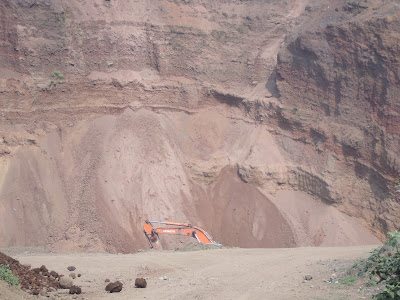
This sand pit is exploited for the rapidly expanding construction sector in Goma which now has a population of over one million inhabitants, many of whom fled the insecurity of North Kivu and have decided to stay.

Entry point in the Virunga National Park to start the approximately five-hour climb up the Nyiragongo which last erupted in January 2002. The volcano sits under the clouds.

The Kibumba market is an important rallying point for the farmers and traders who feed the people of Goma.
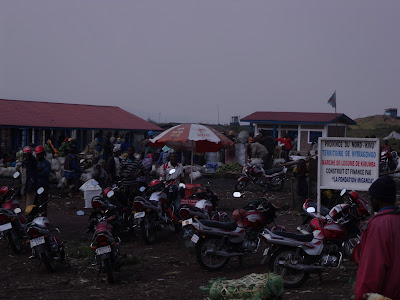
Kibumba

High rural population density means that land use is carefully planned.

Cattle herding is a longstanding tradition in the region.

These are potato plants. Potatoes are an important staple in the Kivu diet.

Young tshukudeur with a sack of potatoes.


It’s a long, dusty and bumpy road.


Insecurity persists in the region despite the presence of UN peacekeepers and the Congolese army.


Dream on.


Access to water is a daily struggle.


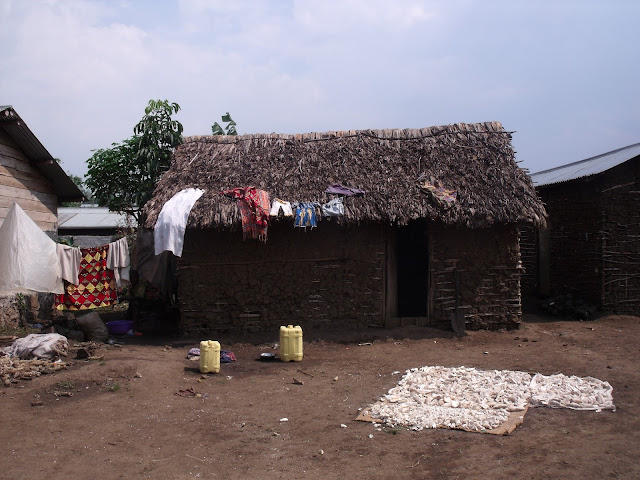
Drying laundry and manioc

Ranger Francine. Women are assuming important roles in the ICCN ranger force.

Virunga park headquarters at Rumangabo


Head warden office building at Rumangabo

Virunga patrol blood hounds

RIP

Pay day at the Katale coffee plantation

Raw coffee

Lucas and I at the Katale coffee plantation
The approximately 50 kilometer drive along the 'Route Nationale 4' took around two hours. As elsewhere in the DRC, the road is slow, bumpy and dusty. Lorries, Jeeps, SUVs, cars, motorbikes, bicycles, tshukudus, cattle herders and pedestrians all converge along this main artery linking Goma and Kampala in Uganda. The road also goes through the beautiful but threatened Virunga National Park - formerly the Albert National Park created in 1925 - Africa's first park.
Although the security situation in Goma has improved over the past year since the defeat of the M23 rebel group, insecurity is still a problem in the region. The population is under threat from militia. One villager told me 'pour la sécurité, on se couche tôt'. Businessmen increasingly complain of hostage taking in exchange of ransom money.
In addition to security problems, natural risks persist. Last night a minor earthquake woke up the people of Goma, but the magnitude of the quake was worse in Bukavu (5.6 on the Richter scale) where it caused the death two children and a police officer. Sixty people were injured. People I spoke with in Goma said they left the house to pray with their neighbors. Everyone was talking about the tremors this morning. By the afternoon the subject was no longer part of the conservation.
The
Rutshuru area is a complex land use mosaic occupied by the Virunga National
Park, rural villages and the Katale coffee plantation.

This sand pit is exploited for the rapidly expanding construction sector in Goma which now has a population of over one million inhabitants, many of whom fled the insecurity of North Kivu and have decided to stay.

Entry point in the Virunga National Park to start the approximately five-hour climb up the Nyiragongo which last erupted in January 2002. The volcano sits under the clouds.

The Kibumba market is an important rallying point for the farmers and traders who feed the people of Goma.

Kibumba

High rural population density means that land use is carefully planned.

Cattle herding is a longstanding tradition in the region.

These are potato plants. Potatoes are an important staple in the Kivu diet.
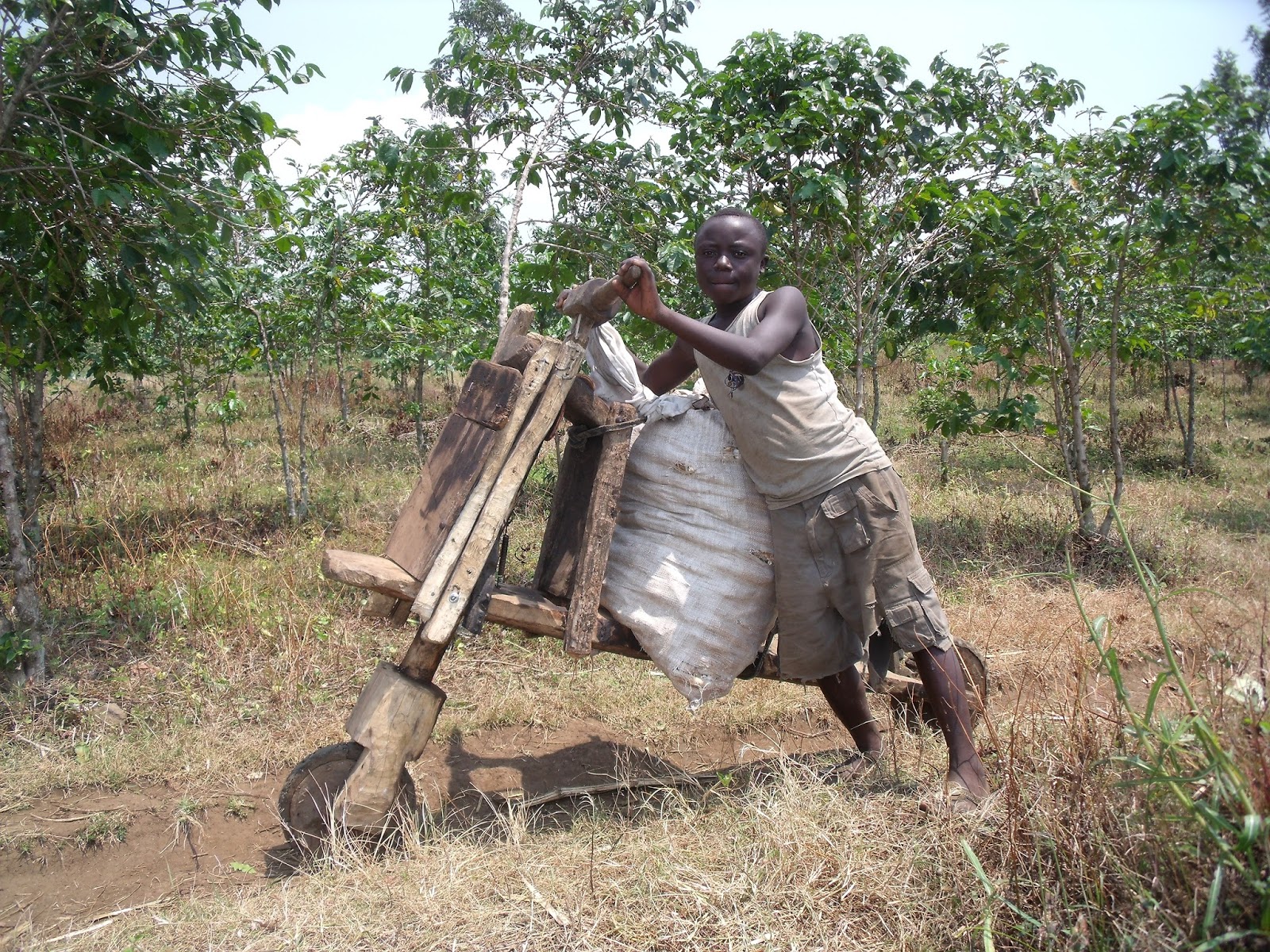
Young tshukudeur with a sack of potatoes.


It’s a long, dusty and bumpy road.


Insecurity persists in the region despite the presence of UN peacekeepers and the Congolese army.


Dream on.


Access to water is a daily struggle.
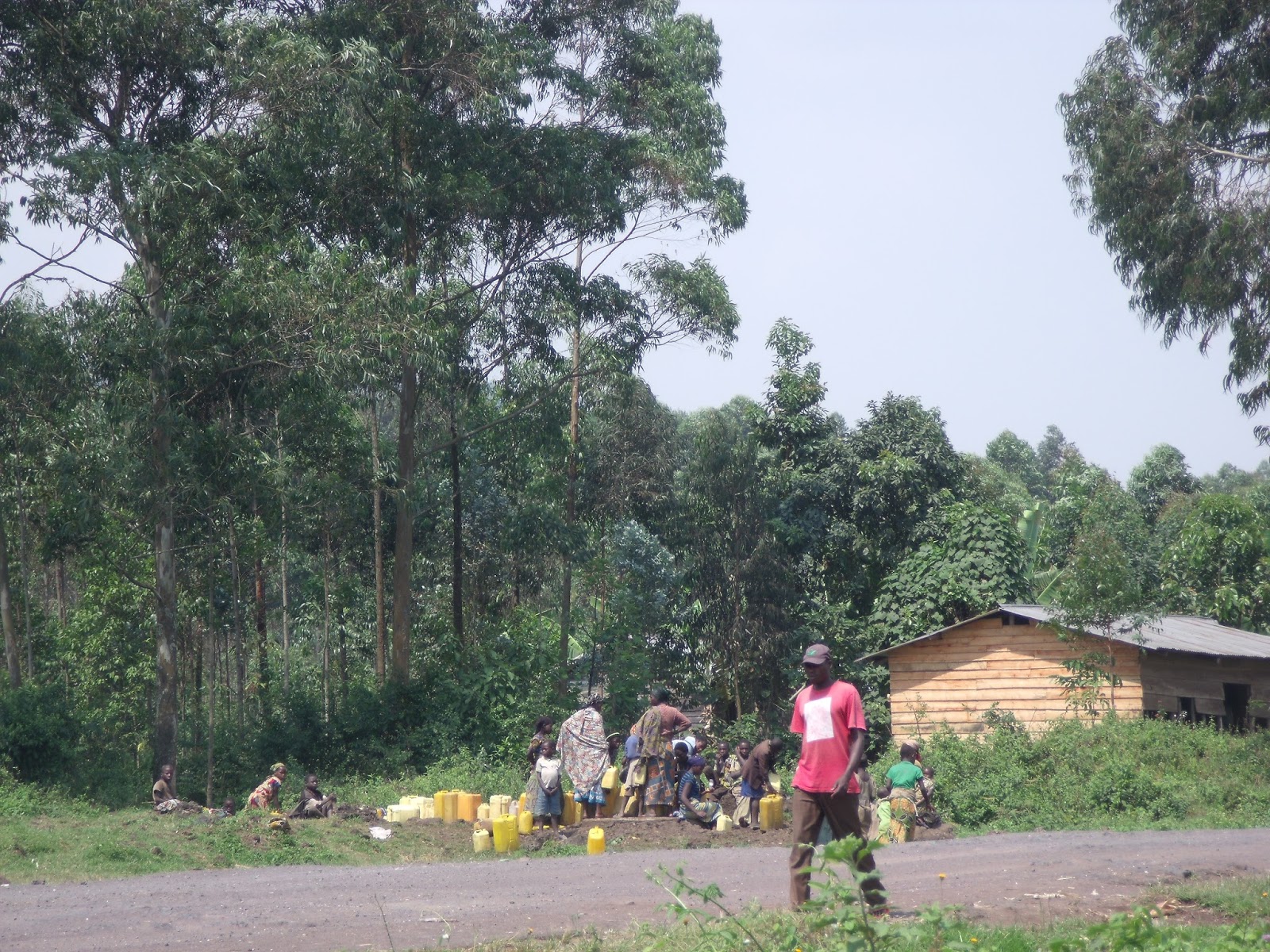


Drying laundry and manioc

Ranger Francine. Women are assuming important roles in the ICCN ranger force.

Virunga park headquarters at Rumangabo
 |
| Baboon in the vicinity of Rumangabo |


Head warden office building at Rumangabo

Virunga patrol blood hounds

RIP

Pay day at the Katale coffee plantation

Raw coffee

Lucas and I at the Katale coffee plantation
Wednesday, 20 May 2015
Optic Fiber Snags
“Millions of dollars were misused in the first phase of a project to build a national fiber optic network in Democratic Republic of Congo, a parliamentary mission has found… In one case, the report says that at least $3.4 million loaned for the construction of a landing station for the submarine cable appear to have been withdrawn from a bank account by beneficiaries ‘not directly linked to the project.’”
For more see Aron Ross’ post.
Subscribe to:
Posts (Atom)